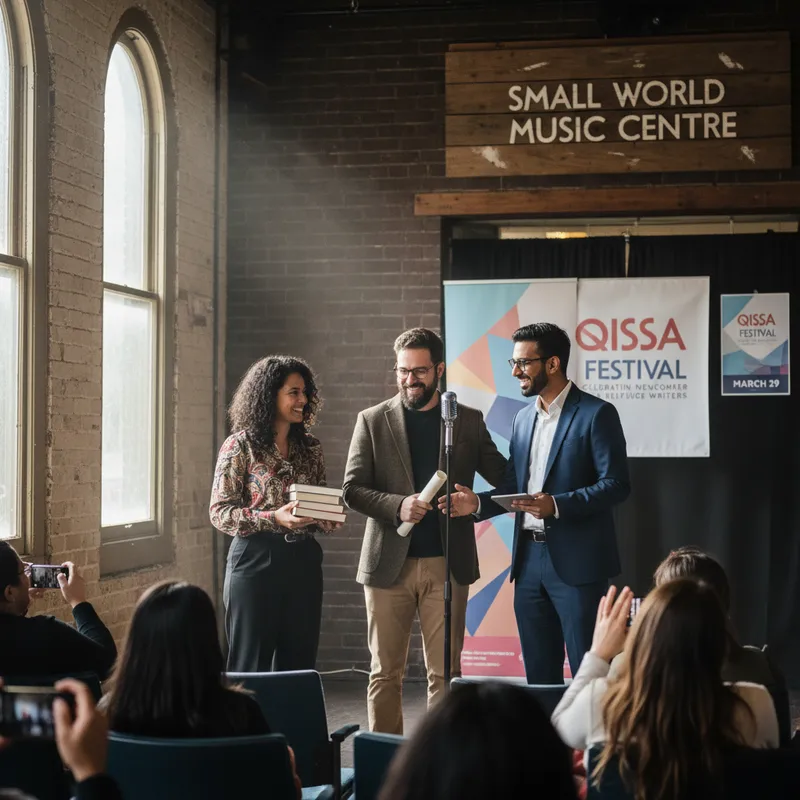
The Qissa Festival will bring together a group of writers, performers, and filmmakers at Toronto’s Small World Music Centre on March 29. The day-long event, titled Celebrating Newcomer and Refugee Writers, aims to move traditional migrant narratives away from the periphery of Canadian literature and into a central performance space. Running from 11 a.m. to 8 p.m., the multidisciplinary programme includes five curated sessions. Organisers say the festival will feature established creators who are currently shaping the local cultural scene, rather than focusing solely on the "emerging" label often applied to newcomer artists. The event follows a growing trend in the city's arts sector to formalise support for diverse creators, similar to how new alliances are standardising other creative industries. The festival arrives at a time when Toronto's arts calendar is expanding to include more specific cultural perspectives. For example, the Toronto spring festival lineup recently confirmed a heavy focus on local diverse talent. The Qissa Festival adds to this by offering a mix of panel discussions, dramatic readings, and musical performances that examine the complexities of moving between countries.
Identity and the migrant body
The morning begins with a session titled “The Art of Small Talk: ‘What Do You Do?’”. This opening event features comic artist and anthropologist Maya El Helou alongside storyteller Blessing O. Nwodo. They intend to use live readings to break down the social rituals newcomers face when defining their professional and personal worth in a new country. In the afternoon, the focus shifts to the psychological effects of displacement. Screenwriter Tala Motazedi and journalist Mostafa Al-A’sar will lead a session called “Mirror, Mirror: Disappearance and the Migrant Body.” The discussion will look at how the physical and emotional self changes when a person is separated from their home environment. This exploration of identity through creative media is a common theme in international arts festivals this year. In Australia, the RISING 2026 programme has similarly prioritised large-scale public art that tackles displacement and urban belonging. In Toronto, the Qissa organisers are keeping the scale intimate to encourage direct dialogue between the performers and the audience.
Letters, food and history
The late afternoon sessions turn toward the tangible links people maintain with their origins. Writer Sana’a Jaber and poet Salman Haider will present “Reappearance: Letters Across Distance and Time.” This session uses music and theatre to illustrate the experience of communicating with family across borders and the eventual reality of reunion. Food and history take the stage in a presentation by researcher Harleen Singh and broadcaster Ahmer Naqvi. Their session, “Empire, Movement, and Food,” includes a dramatic reading and a participatory segment. It examines how the history of various empires continues to influence what people eat and how they move across the globe today. The festival will also feature a keynote address from Randell Adjei. Adjei is a spoken-word artist and the founder of R.I.S.E. Edutainment, an organisation that uses performance art for youth empowerment. As Ontario’s first Poet Laureate, his involvement signals the high profile of the event’s contributors. Information on his work can be found via Ontario’s cultural resources.
Access and registration
The event concludes with a screening of short films by Motazedi and Jaber. This will be followed by a talk with the filmmakers and a musical performance supported by the Small World Music Centre. Organisers have set the recommended age for attendees at 16 and older due to the mature themes discussed in the presentations. While the festival is free to attend, the organisers are operating on a community-supported model. Attendees can choose to make optional contributions between $15 and $100. These funds go directly toward supporting the artists and future programming for Qissa. Seating at the Small World Music Centre is limited. The organisers require attendees to reserve spots for individual sessions through an online booking system. Registration is currently open for all five sessions of the day.