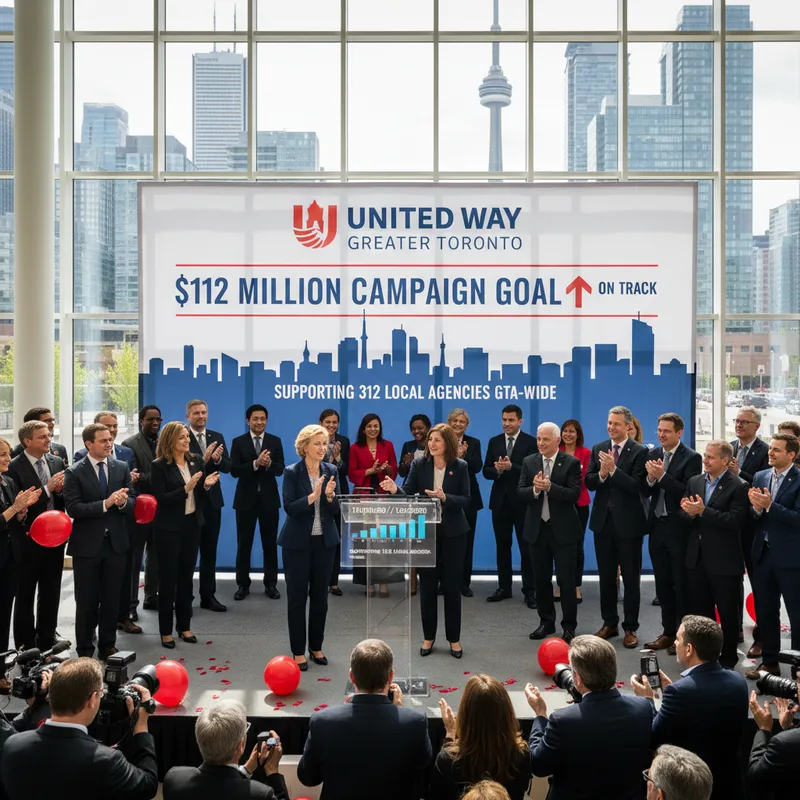
United Way Greater Toronto expects to reach its $112 million fundraising target for the 2025 community campaign, marking a significant injection of capital into the region's social safety net. The projected total comes as the organisation struggles to keep pace with rising demand for housing and food security across Toronto, Peel, and York Region. The figures, released at the annual Local Leaders reception on Friday, show that the organisation is on track to hit its goal by the end of the fiscal year. More than 300 workplaces across the Greater Toronto Area participated in the drive, which funds a network of 312 agencies. These frontline groups provided services to 1.8 million people last year, according to United Way Greater Toronto. President and CEO Heather McDonald said the success of the campaign reflects a collective effort at a time when residents are feeling significant financial pressure. She noted that the fundraising allows local agencies to keep their doors open and provide help that is desperately needed in high-needs neighbourhoods.
Focus on housing and employment
Housing stability remains the primary concern for the organisation. Internal data shows that 34,531 people who were unhoused or at risk of losing their homes received support through funded programs last year. This work also includes the development of 288 affordable and supportive housing units currently in the planning or approval stages. The labour market continues to present challenges for long-term stability, particularly for newcomers. United Way reported that its employment programs helped 21,572 people find work last year. More importantly for long-term recovery, 4,774 of those individuals remained in their roles for at least twelve months. While the $112 million total is substantial, the scale of the crisis requires constant resource allocation. The investment in jobs and housing is designed to create a foothold for families struggling with a shifting economic environment and the high cost of living in the GTA.
Capital and neighbourhood grants
Beyond immediate service delivery, the organisation is investing in the physical infrastructure of social services. Between 2024 and 2025, United Way provided $2.1 million in capital grants to 13 different agencies. These funds were used to renovate and expand community service spaces, ensuring that the buildings where care is delivered remain functional. The organisation also expanded its Community Action Grant program with a $1.13 million investment specifically for Jane Finch, Cooksville, and South Markham. This funding supports 28 projects that were identified by residents rather than administrators. These projects cover a range of issues including mental health, anti-displacement measures, and sensory health initiatives. Physical hubs also saw a surge in usage. Local centres recorded 725,266 visits last year as residents sought out programs close to their homes. These hubs serve as a critical link during emergencies and peak periods of need for local families.
Workplace giving drives results
The campaign relies heavily on corporate and labour partnerships to reach its nine-figure targets. Norie Campbell, the Campaign Cabinet Chair and Chief Legal Officer at Thomson Reuters, said leading the fundraising team was a rewarding experience. She noted the willingness of volunteers across the region to participate in the mission. "The mission of UWGT is so compelling and finding so many people across Greater Toronto who were inspired to put their hand up to help in that mission was so rewarding for every volunteer across the campaign," Campbell said. Workplace campaigns often involve employees organising internal events, payroll deductions, and volunteer drives. This model has become a staple of local corporate social responsibility, particularly as tech and industrial demand fluctuates. These efforts coincide with other major regional events, such as when TMX Group hosts global mining leaders or when local sports centres open internship applications for the coming year.
Next steps for the 2026 cycle
The current fundraising cycle will conclude at the end of the fiscal year. Once the final tallies are confirmed, the funds will be distributed across the 312 partner agencies to sustain operations through the next winter season. United Way officials say they will continue to monitor the impact of the Community Action Grants in the three priority neighbourhoods. The organisation expects to announce its formal strategy for the 2026 campaign in the fourth quarter. This will include updated targets based on the final performance of the current $112 million drive. Local agencies are currently submitting data to help determine where the greatest gaps in service delivery remain for the upcoming year.