
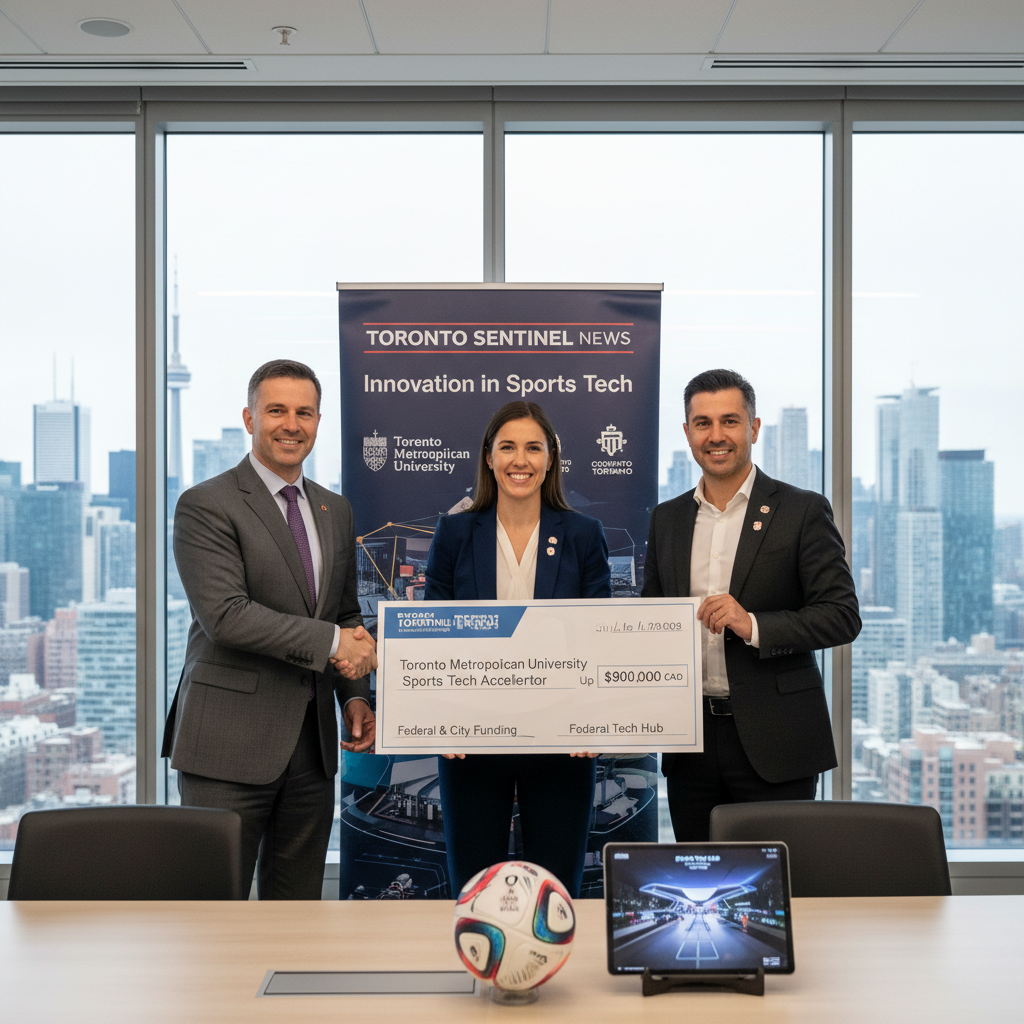
The federal government and the City of Toronto are teaming up to invest as much as $900,000 into a new sports technology accelerator at Toronto Metropolitan University (TMU), a strategic initiative designed to capitalize on the city’s role as a host for the 2026 FIFA World Cup.
The project, named the Future of Sport Lab x FIFA 2026 Legacy Incubation Hub, will be delivered by TMU and aims to support up to 60 startups annually. The announcement confirms a significant commitment to fostering innovation in the city's burgeoning tech sector, using the global sporting event as a catalyst for long-term economic growth.
The federal government, through the Federal Economic Development Agency for Southern Ontario (FedDev Ontario), is providing the bulk of the funding with a $600,000 commitment. The City of Toronto is contributing up to $300,000, with additional support coming from undisclosed private sector partners and sports organizations.
A legacy project for the World Cup
Officials announced the partnership at the TradeTO Trade Diversification Summit at Toronto City Hall, framing it as a key part of the city's strategy to ensure the World Cup leaves a lasting impact beyond the tournament itself. Hosting the global event involves significant public expenditure, including major renovations to local stadium infrastructure, and this initiative seeks to generate a return on that investment by nurturing local businesses.
The hub is designed to answer the question of how a massive, temporary event like the World Cup can be leveraged to create permanent economic benefits. Rather than focusing solely on tourism and hospitality, the city is betting on the high-growth sports technology sector. This aligns with other municipal efforts to manage the financial commitments of hosting, such as the strategy of selling tickets to offset hosting costs.
Rechie Valdez, Canada’s secretary of state for small business and tourism, spoke at the summit about the unique alignment of interests that made the hub possible.

Building on a growing tech scene
The investment comes as technology plays an increasingly critical role in professional sports. From AI-driven performance analysis and computer-vision tracking of players to in-ball sensors that provide real-time data, innovation is reshaping how games are played, coached, and consumed by fans. The 2026 World Cup itself will prominently feature many of these advanced technologies.
Canada, and Toronto in particular, is seen by some industry experts as an emerging leader in this space. Julien Blin, CEO of the American sports tech consultancy Upside Global Org, argued last year that the country's strong talent pool and supportive ecosystem are making it a quiet hotbed for sports innovation. This new accelerator aims to formalize that status and provide a dedicated pathway for local startups to scale. The program will be managed by TMU's Future of Sport Lab (FSL), which is well-positioned for the task. Established in 2015, the FSL has a proven track record of giving Canadian startups invaluable access to professional sports franchises and industry leaders. This new funding will significantly expand its capacity and mandate, building on years of foundational work connecting entrepreneurs with the established sports world. In the context of global sporting events, we recently saw Brampton's Cyle Larin score a historic goal for Canada. The university's continued expansion, including the recent opening of its new medical school in Brampton, highlights its growing role as a key institution for regional development.
How the accelerator will work
The Future of Sport Lab x FIFA 2026 Legacy Incubation Hub will function as a business accelerator, providing cohorts of early-stage companies with mentorship, resources, and networking opportunities. Startups accepted into the program will gain access to a curriculum designed to address the specific challenges of the sports industry, from product development and intellectual property to market entry and securing pilot projects with professional teams.
The annual programming is expected to attract a wide range of companies. These could include firms developing next-generation wearable technology for athletes, platforms for enhancing fan engagement, software for stadium management, and data analytics tools for scouting and coaching. By supporting as many as 60 startups each year, the hub will create a powerful engine for job creation and intellectual property development in a highly specialized field.
The direct link to the FIFA World Cup provides a unique platform for these emerging companies. The global spotlight on Toronto will offer unparalleled visibility and potential partnership opportunities with international sports federations, media outlets, and major brands converging on the city. More information on the federal government's investment can be found in its official press release.
As other Canadian cities like Calgary also leverage major events to boost their local economies, this initiative in Toronto stands out for its targeted focus on a specific, future-focused industry. The federal government has noted that it expects the World Cup to provide a significant boost to the Canadian economy. With this commitment, the government and the city hope to ensure Toronto’s investment in hosting the games creates what they call “a lasting economic legacy” for domestic sports tech firms.