
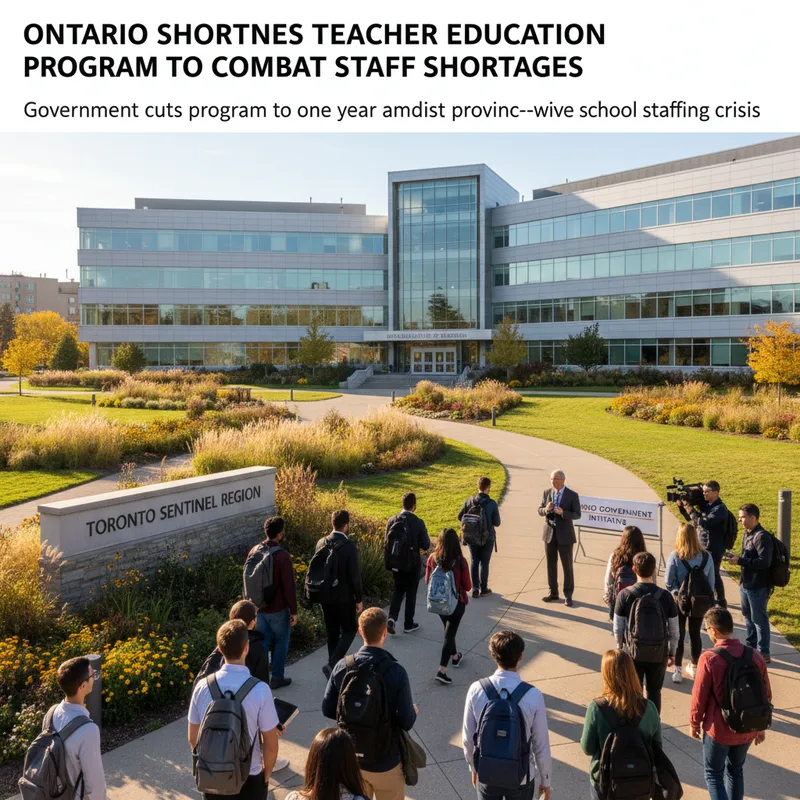
The Ontario government announced Friday it is cutting teacher education programs from two years to one, a move it says will get more teachers into classrooms faster to help address a critical staffing shortage across the province. The new model will require legislative changes and is set to launch in May 2027.
At a press conference, Minister of Education Paul Calandra and Minister of Colleges and Universities Nolan Quinn outlined the plan to overhaul the current system. Starting in 2027, all 14 public and three private universities in Ontario offering teacher education will be required to adopt a compressed one-year, three-semester format. This change will replace the four-semester, two-year program that has been the standard.
The government says this streamlined approach will not only accelerate the path to certification but also reduce the financial burden on students. By shortening the program, prospective teachers could save up to $3,000 in tuition fees. "This change will get future teachers into the classroom faster, jumpstarting fulfilling careers and meeting the needs of communities across Ontario," Quinn said.
A focus on practical experience
A central component of the reform is an increased emphasis on practical, in-classroom experience. While the current minimum for practicum placements is 80 days, the government plans to establish a new, higher standard. Education Minister Paul Calandra stated the current requirement is "absolutely not long enough" for preparing new teachers for the realities of the classroom.
"They have to be in front of a classroom for a longer period of time," Calandra said. "The goal is to make it one of the highest practicums in the country and I think that will lead to better results for our student teachers." Further details on the new minimum length for placements were not immediately available.
In addition to extending practicums, the province will also look at ways to recognize relevant prior learning and work experience for those entering the profession. This could include credentials like early childhood educator diplomas or significant experience working with youth, potentially creating a faster pathway for individuals with related skills. The move comes as Ontario schools struggle with significant and persistent staffing gaps. A 2024 report from the public education think-tank People for Education highlighted the severity of the crisis. Similar issues have surfaced in Wellington, where the football club needs 40 coaches as the volunteer crisis deepens. The report found that 24 per cent of elementary schools and 35 per cent of secondary schools face daily shortages of teaching staff. The problem is even more pronounced for educational support staff, with 42 per cent of elementary and 46 per cent of secondary schools reporting daily shortfalls.
Unions raise retention concerns

While the goal of getting more teachers certified is seen as a positive step, teachers' unions argue the plan fails to address the core reasons why so many are leaving the profession. Shirley Bell, first Vice President of the Elementary Teachers’ Federation of Ontario (ETFO), described the announcement as a "partial good news story."
Bell acknowledged that shortening the program could lower financial barriers and help increase diversity among teacher candidates. However, she stressed that recruitment is only half the battle. "I think the biggest issue is not just recruitment, but it is retention," she said. "That is the biggest issue we have, retaining the teachers we have. They leave pretty quickly upon entering into the school system and this does not address the real working conditions of the teachers in the system and other educators."
This only opens the front door and right now teachers are walking out the back door. To me, this isn’t a pipeline problem; it is a retention crisis.
This sentiment was echoed by the Ontario Secondary School Teachers’ Federation (OSSTF). Bell and other union leaders argue that to truly solve the shortage, the government must make significant investments to improve working conditions, such as reducing class sizes and hiring more support staff to assist students with higher needs. According to the Ontario College of Teachers, there are currently 76,000 qualified teachers in the province who are not actively teaching in the public system, a statistic that unions say points to a problem with retention, not supply.
A history of abrupt reforms
The Ontario Teachers’ Federation (OTF), which represents the province's certified teachers, expressed disappointment that it was not consulted on the changes. In a statement, OTF President Chris Cowley noted that while the federation has long supported a 12-month program, the lack of collaboration is a major concern. The federation is worried that the timeline for implementation is not feasible without proper support for the universities that need to overhaul their programs.
The government's approach is reminiscent of other major, unilateral reforms it has undertaken, such as the 2018 decision to cut the size of Toronto's city council nearly in half during a municipal election. That move, which was ultimately upheld by the Supreme Court of Canada, was made without consultation with the city and caused significant disruption. Similarly, this education reform was announced with a tight deadline and without input from key stakeholders like the OTF and faculties of education, raising concerns about a smooth transition.
As the province prepares to table the new legislation next week, universities and school boards will be watching closely for details on funding and support to manage the complex programmatic changes. The government's ability to navigate these implementation challenges will determine whether the reform can genuinely ease the teacher shortage or if it will simply create new problems. Many educators remain skeptical that shortening training, without addressing the underlying causes of burnout, will be enough to keep teachers in the classroom.
With the changes not taking effect until 2027, the immediate staffing pressures on schools will persist. The government's official announcement stressed a commitment to a modernised system, but the focus for many remains on the present crisis.
"We are concerned that the announced timelines for implementation will not be feasible," Cowley's statement concluded, highlighting the significant challenges that lie ahead for Ontario's education sector.