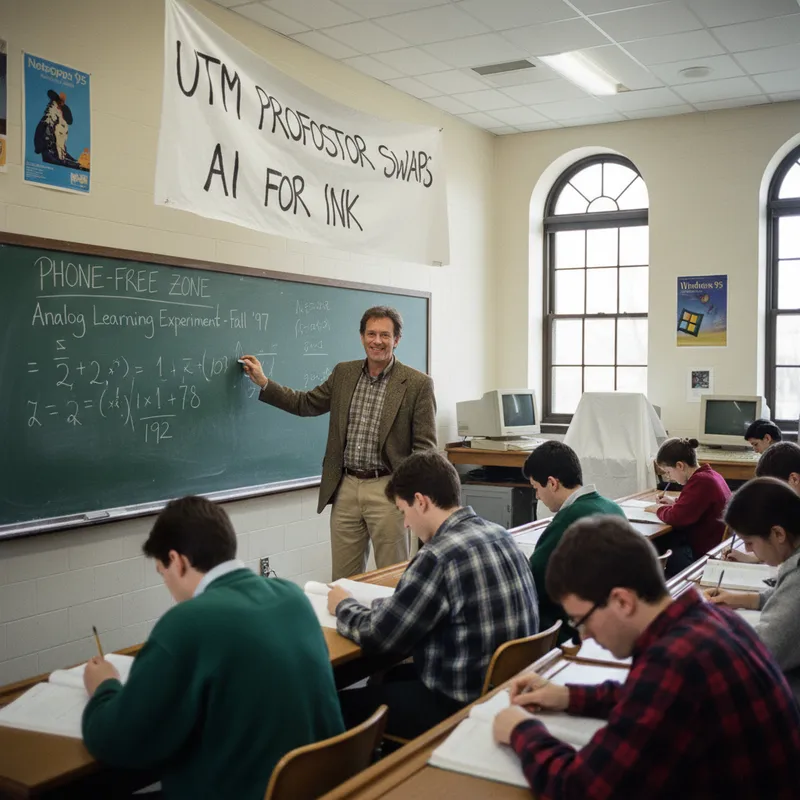
Students at the University of Toronto Mississauga (UTM) traded their laptops for notebooks and pens this semester as part of a classroom experiment to improve engagement and curb reliance on artificial intelligence. Mustafa Siddiqui, an assistant professor at UTM’s Institute for the Study of University Pedagogy, removed all digital technology for a three-hour session of his university writing course. The session required students to leave smartphones, smartwatches, and laptops in their bags. Instead of digital slides, Siddiqui used a whiteboard, a physical pointer, and paper handouts. The move follows a general trend in Ontario where families seek alternatives to traditional tech-heavy schooling to improve student focus. Siddiqui said the idea for the 1990s-themed class came after he noticed a decline in student interaction and a lack of original thought during brainstorming. He observed that students frequently relied on generative AI or existing internet content rather than developing their own ideas. He decided to test if "human intelligence" would flourish without digital aids.
Back to basics in the classroom
The professor dressed the part for the experiment, wearing a formal jacket and tie. He abandoned the podium, where he is usually tethered to a computer, and moved around the room to interact with students. This change in physical presence allowed him to stay closer to the class throughout the lesson. Students also embraced the theme. Some arrived wearing clothing borrowed from their parents, while others brought authentic accessories like a Discman or a physical newspaper. One student reported that the lack of screens made it easier to focus on critical discussions with their peers. While the delivery method was old-fashioned, Siddiqui maintained modern teaching techniques. The class still included the active learning and group work protocols used in his standard curriculum. The difference was the medium through which those tasks were completed.
Addressing the impact of AI
The rise of generative AI has forced universities to reconsider how they assess original work. Siddiqui noted that the tech-free environment forced students to generate ideas without the help of algorithms. He said he was elated to see students immediately reaching for pens and paper once the lecture began. According to student feedback collected on paper forms at the end of the session, the experiment was a success. Several students mentioned that handwriting notes helped them retain information more effectively than typing. Others described the absence of digital distractions as a "breath of fresh air" for their concentration. This shift mirrors broader efforts across various sectors to re-evaluate the role of technology in skill development. For example, some government initiatives, such as those seen when the NSW Government opens new roles for hands-on trades, emphasise practical, pen-and-paper fundamentals before moving to complex digital systems.
Future research and expansion
Siddiqui plans to make the tech-free session a permanent fixture in his courses. He intends to run at least one "90s-style" class every term. The initiative aligns with his institute’s broader goal of finding new ways to improve how students learn in the digital age. The experiment has also caught the attention of other faculty members. Another writing studies professor at UTM has expressed interest in adopting a similar "analog" session for their own classes. This cross-department interest suggests a growing appetite for hybrid teaching models that balance technology with traditional methods. Siddiqui will take his findings to a national audience this June. He is scheduled to discuss the results of the experiment at the Federation for the Humanities and Social Sciences summit in Edmonton. The presentation will focus on how occasional screen-free learning can benefit student performance. There is also a possibility that the trial will lead to a formal research project. Siddiqui and his colleagues are considering a study to quantify how tech-free sessions impact long-term learning outcomes. This research would look at whether the engagement seen in the one-off session can be sustained over a full academic year. For now, the project remains a targeted intervention designed to remind students of their own cognitive capabilities. Siddiqui says that while technology is common in today's world, providing a new environment where learning still happens without it can be a valuable tool for educators.