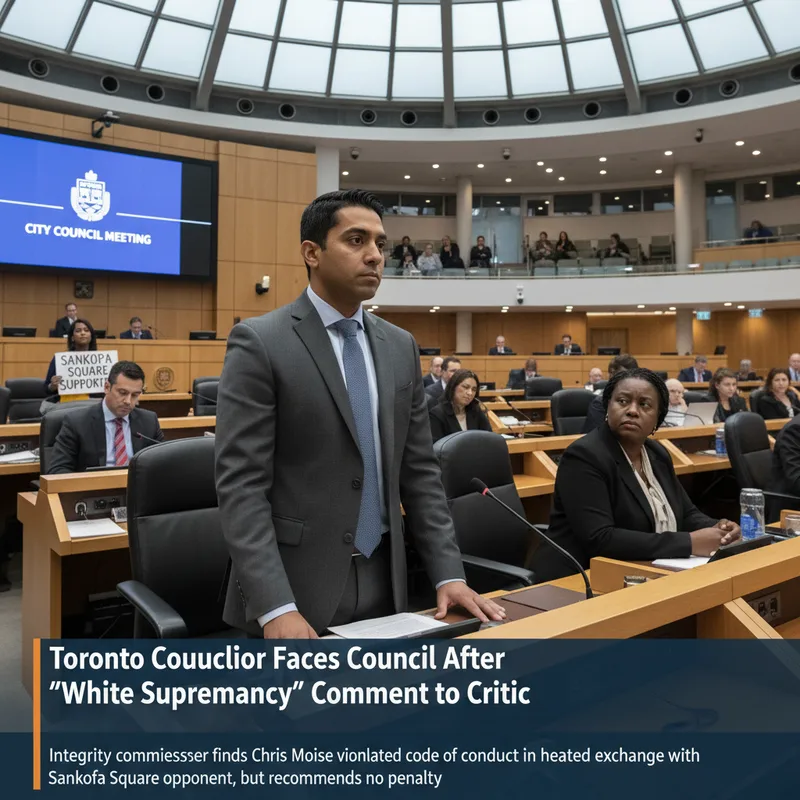
The city's integrity commissioner has found that a downtown Toronto councillor violated the Code of Conduct during an interaction with a constituent last year but is not recommending a penalty.
The dispute centres on an exchange that occurred on Jan. 16, 2025 after a budget town hall at City Hall, when Moise was approached by Daniel Tate, the executive director of the advocacy group IntegrityTO. Tate, who recorded the interaction, asked Moise what he was doing in 2025, "relating to renaming things that hurt your feelings for whatever reason?"
The confrontation laid bare tensions that have simmered since council approved renaming Yonge-Dundas Square to Sankofa Square — a decision that has divided Toronto residents. Despite a 35,000-person petition, City Council went ahead with the renaming initiative, confirming to residents that local government was neither safeguarding their best interests nor acting as responsible stewards of tax dollars, according to IntegrityTO's website.
In response to Tate's questioning, Moise said, "I know you have a white supremacy view. I don't support your views." When Tate asked for an apology, Moise responded that he would never apologize, "because you are."
A clash over toronto's identity
The exchange between Moise and Tate represents more than a personal dispute — it reflects deeper divisions about how Toronto confronts its history. Council voted in December to change the name of the space to Sankofa Square and recommended other landmarks be stripped of the Dundas name over Henry Dundas' connections to the trans-Atlantic slave trade.
The Indigenous leaders on the committee recognized the significance of this decision as it pertains to the legacy of the Transatlantic slave trade and supported the proposed name, as it resonates with the history and experiences of the Black community in Toronto. Sankofa represents the idea of drawing strength and wisdom from the past to build a positive future.
But the renaming has faced fierce opposition. A January 2024 poll reported by CTV News found that 71% of Toronto residents surveyed opposed the renaming. Critics argue the new name lacks connection to Toronto's history, while supporters say it acknowledges painful aspects of the past that need addressing.
"We encourage our children and others that if they see something, say something," said Moise in a statement. "As an elected representative, it is incumbent on me to lead by example and stand up to racism, bigotry, and marginalization." Moise said he "respectfully disagrees" with the commissioner's report and has no regrets for standing up to white nationalism.
Tate, for his part, founded IntegrityTO after becoming frustrated with what he saw as ideological excess at City Hall. In January, he made headlines with a "taxpayers' land acknowledgement" at a budget meeting, declaring that "every word spoken in this chamber, every light bulb, and every salary paid" was funded by taxpayers, not ideology.
Commissioner's nuanced finding
Integrity Commissioner Paul Muldoon submitted his final report on two complaints filed against Coun. Chris Moise this week. While finding Moise violated the code of conduct, the commissioner's reasoning for not recommending a penalty reveals the complexity of the situation.
"The Councillor was caught in a brief reactive exchange with one of his most vocal critics, who was persistently pursuing the Councillor in a manner likely to elicit an emotional response," the commissioner wrote. "In his submission, the respondent said that, as a Black man who has experienced racism and hate throughout his life, the complainant's persistent criticisms of equity-based projects, and of the Councillor himself, are connected to racism."
Muldoon's report also said it considered Moise's alleged claim that Tate's tone and language during the incident "were confrontational" to "elicit and catch on video a reaction… described as a 'gotcha moment.'"
Moise went on to say that during the incident, he was "cornered by a handful of people in addition to Tate," some of whom may have been his associates or organization's volunteers. Moise called that moment a "deliberately orchestrated ambush."
Tate calls this recollection by Moise "a complete cop out" and that councillors should give constituents the opportunity to ask hard questions. "If you can't handle the heat or tough questions at city hall, then maybe you should pick a different career," he said.
What happens next
The matter will now go before Toronto's city council to either accept, reject or revise the recommendations by the commissioner. Council cannot alter the commissioner's findings but could choose to impose a penalty despite the recommendation — potentially a reprimand or suspension of pay for up to 90 days.
The case has broader implications for how elected officials engage with critics. "In closing, this matter serves as a reminder that while disagreement is inevitable in a vibrant democracy, the way we engage with one another matters. Members of Council hold positions of public trust, and with that, the responsibility to model high standards of respectful conduct," the commissioner wrote.
For Tate, the lack of penalty sends the wrong message. "You're not really sending a strong message, if there's no sanction as a result of this bad behaviour," Tate said, adding he hopes council will choose to issue a penalty to show there are "tangible consequences" for violating the city's code of conduct.
The confrontation between Moise and Tate over Sankofa Square reveals how Toronto's attempts to reckon with history have become flashpoints for deeper conflicts about identity, democracy and the limits of political discourse. Whether council accepts the commissioner's recommendation or charts its own course will signal how it believes elected officials should handle passionate disagreement in an increasingly polarized city.