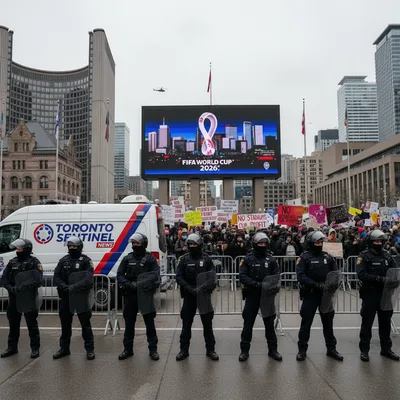
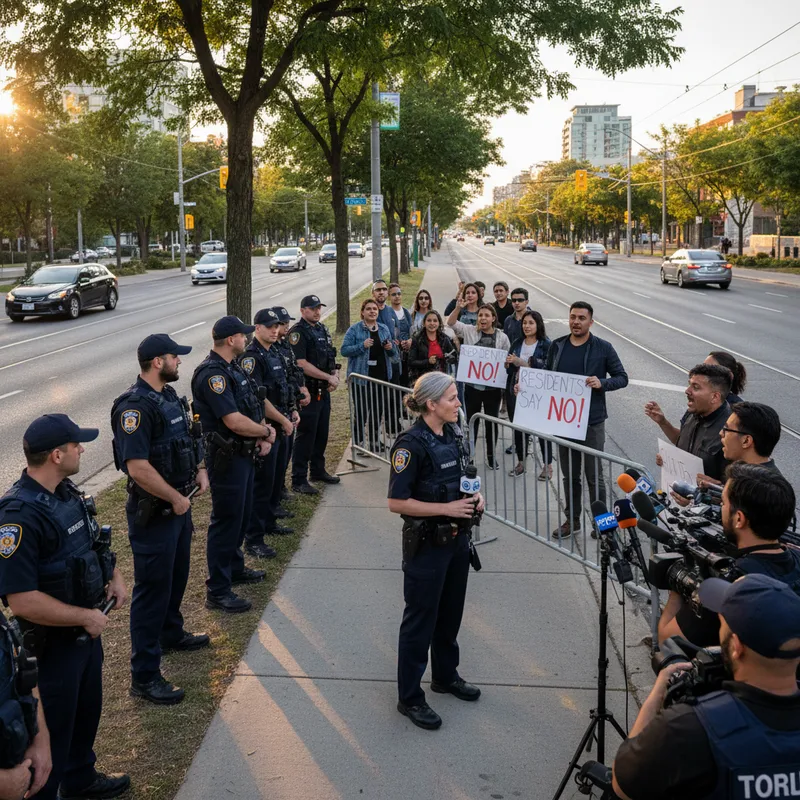
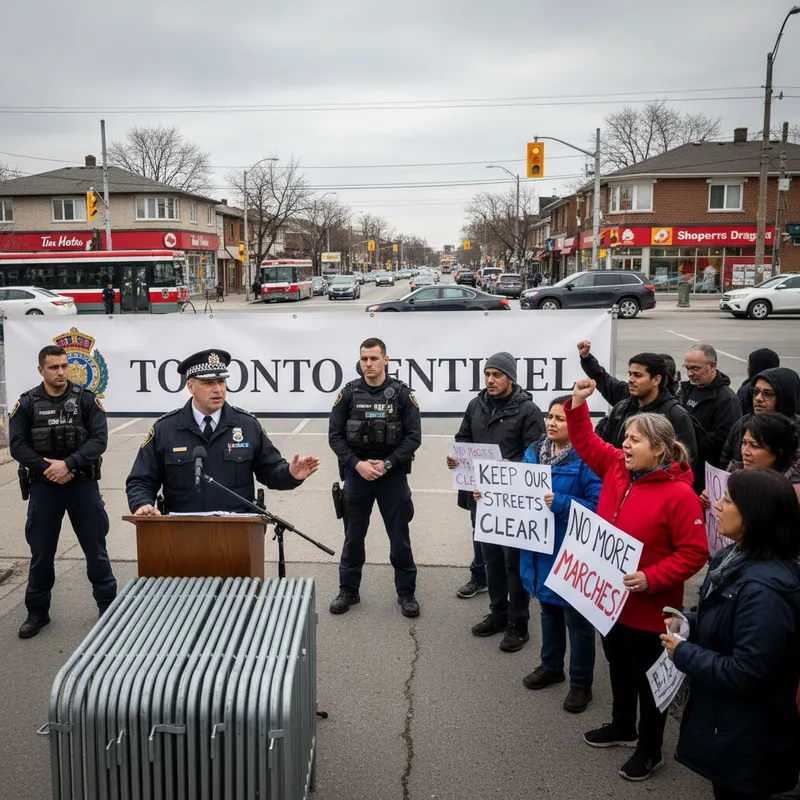
A heavy police presence of more than 80 officers monitored duelling demonstrations at the intersection of Bathurst Street and Sheppard Avenue on Sunday, outnumbering the roughly 50 protesters and keeping a tense peace. But new rules intended to quell frustrations in the community have sparked confusion and anger, with some residents feeling misled about the scope of the police-enforced protest zones.
The weekly gatherings have been a flashpoint for over two years. On April 5, two weeks after the Toronto Police Service announced new rules of engagement, anti-Israel protesters changed their tactics. Instead of a single large group, they split into smaller clusters, with some heading south on Bathurst Street towards Earl Bales Park, home to the city’s main Holocaust memorial, while others walked in small groups west along Sheppard Avenue.
While no arrests were made and police reported no one entered residential side streets, which are now designated no-go zones, the continued presence of marchers along major arterial roads has left many residents feeling that the situation has escalated rather than improved.
Police clarify ‘misunderstood’ rules
Sherry Gallowitz, a local resident who lives west of the intersection, approached officers before the protest began on Sunday to voice her concerns. She says she, like many others, believed the new rules would confine protesters to the intersection itself.
“I had understood, the week prior, I saw a video that they were going to require them to disperse after the rally and not go into the residential streets,” Gallowitz says. After speaking with a police commander, she learned that major roads like Bathurst and Sheppard are not considered residential streets under the new rules. “They are allowed to keep doing what they’re doing and that now to start marching up and down Sheppard I guess, and that’s an escalation.”
Gallowitz described the allowance as outrageous and questioned why a residential neighbourhood should be a target for such demonstrations. “I don’t see why it’s a Charter right to be able to walk through a residential neighborhood. There is no target here other than the people that live here,” she says.
I find it outrageous. And I also get very upset that for all this time… it hasn’t been very reported on. I get to see them screaming with their megaphones into the faces of elderly people just trying to get to the drugstore or the grocery store.
Gallowitz also challenged the distinction between houses on quiet streets and the numerous apartment and condominium buildings that line Sheppard Avenue. “I don’t understand, it seems discriminatory to me,” she says, arguing that those in high-rises are just as much residents of the neighbourhood as those in single-family homes.
Arrest and ‘escalation’ prompted changes
Inspector Israel Bernardo, the senior officer in charge on Sunday, acknowledged the community’s confusion but defended the police’s approach, citing the need to balance public safety with the right to peaceful protest guaranteed under the Canadian Charter of Rights and Freedoms.
“The plan is to ensure community safety,” Bernardo says. “There’s also a right to protest, which under the Charter that people have, but it has to be reasonable and we’re not going to allow them to protest in residential areas.”
Bernardo clarified that main thoroughfares with public transit and multiple lanes, like Bathurst and Sheppard, cannot be entirely restricted. “It’d be difficult to put limitations on Bathurst when the bus goes all the way up. And Sheppard? It’s a long street,” he says. The decision to implement new rules followed what police described as an “escalation in behaviour that became a clear risk to public safety.” This included a significant hate crime investigation that led to the arrest of a 33-year-old man, Muhammed Anas Sial, for public incitement of hatred. Police seized antisemitic signs allegedly used at a March 15 protest at the same intersection. Similar issues have surfaced in Melbourne, where police officers have faced scrutiny over their actions in Indigenous death inquests.
A neighbourhood on edge
The recent arrest is one of several incidents that have put the local Jewish community on high alert, including recent gunfire targeting three synagogues and several Jewish-owned businesses. According to police, these events necessitated a more structured approach to the ongoing protests.
For residents like Gallowitz, the past two years of disruption have taken a toll. She expressed deep frustration with the ongoing situation. "I drive by here every Sunday. I get to see them screaming with their megaphones into the faces of elderly people just trying to get to the drugstore or the grocery store," she says. Her one-word description of her feelings now: “Frustrated. Very frustrated. And angry and upset and fed up.”
The challenge of policing protests in a dense urban environment is not new to Toronto, which saw over 1,000 arrests during the G20 summit protests in 2010. However, the sustained nature of the demonstrations at Bathurst and Sheppard presents a unique and ongoing challenge for law enforcement as they navigate complex legal rights and community anxieties in a neighbourhood that feels targeted.
As police continue to monitor the weekly gatherings, Inspector Bernardo says they must remain ready for any possibility. “I just think we have to be prepared, and it was a great idea by Command,” he says of the enhanced police strategy.