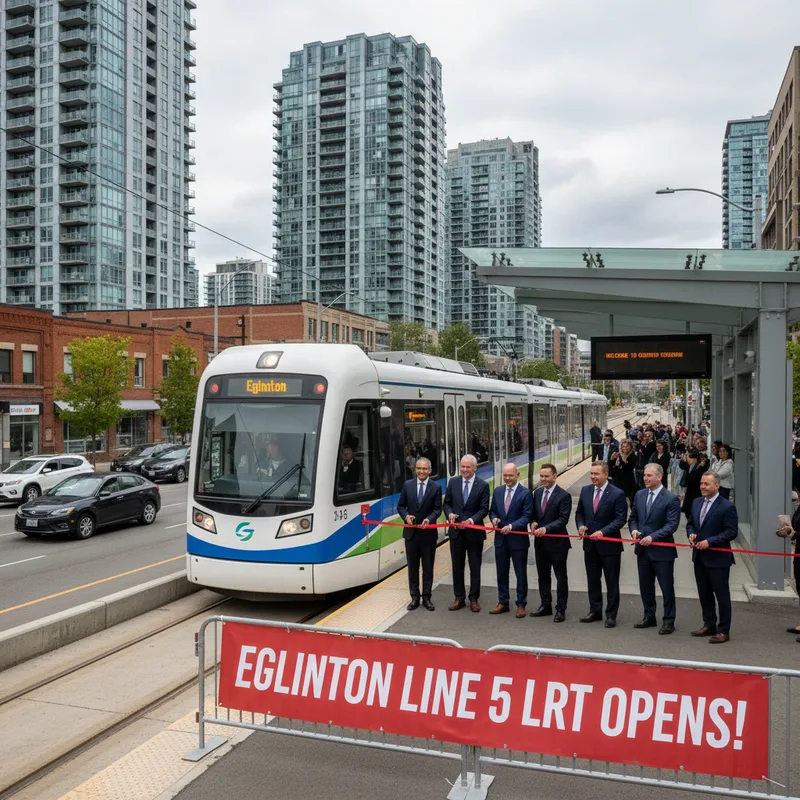
After years of construction and multiple delays, Toronto's much-anticipated Line 5 Eglinton has officially opened, ushering in a new era of public transit for the city's Midtown. The 19-kilometre light rail transit (LRT) line, which began serving riders in February, features 25 new stations connecting to multiple train lines and providing crucial cross-town access for one of Toronto's fastest-growing areas.
The project, which first began construction in 2011, represents one of the most significant transit expansions in North America in recent decades. It includes a 15-station underground section, making it one of the longest new subterranean metro lines completed in Canada or the United States in the 21st century, comparable in scale to Vancouver's 2009 Canada Line.
The opening marks a major milestone for a city grappling with explosive population growth. As the fastest-growing metropolitan area in both Canada and the U.S., Toronto has been in dire need of expanded transit infrastructure. The Line 5 project was initiated in the 2000s to address this demand, though it faced a number of settlements and delays that pushed its completion back by about six years.
A unified design for a diverse cityscape
The most visible elements of the new line are its stations, which were designed to seamlessly integrate into the varied urban landscape of Eglinton Avenue. A consortium of design and engineering firms, including Arcadis, AtkinsRéalis, Daoust Lestage Lizotte Stecker, NORR, and Dialog, led the architectural vision.
The 15 underground stations are categorized into three distinct typologies: corner, embedded, or pavilion. This approach allowed for flexibility in how each station interacts with its immediate surroundings. Embedded stations, for instance, are built directly into the infrastructure with slabs strong enough to support future overhead buildings, while pavilion stations create standalone glass structures that filter natural light deep underground.
Despite these different forms, a consistent design language ensures a unified identity across the entire line. Arcadis lead designer Lisa D'Abbondanza says the goal was to create stations that are light-filled hubs during the day and glow as welcoming beacons at night.
Every element was designed for intuitive, connected journeys and addressing the needs of the city, the neighbourhood, and the individual. These typologies strengthen each neighbourhood, but maintain a unified architectural language throughout.
Innovation below and above ground
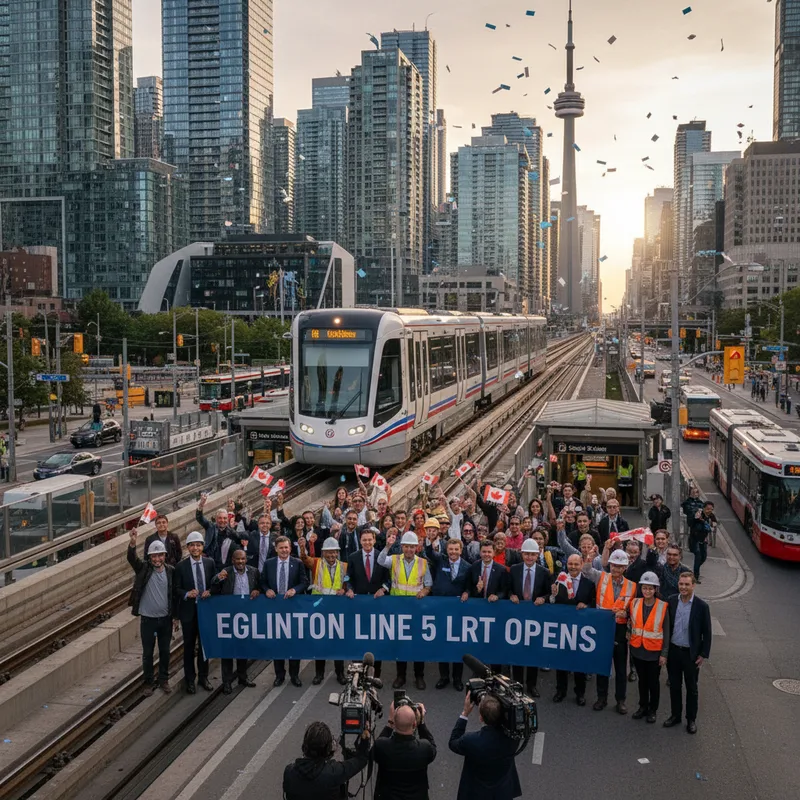
Bringing a project of this magnitude to life in a dense urban environment required significant engineering innovation. The construction team utilized a sequential excavation method and some top-down construction techniques to build the line while minimizing disruption to traffic flow on Eglinton Avenue above. The strategic use of shotcrete, a sprayable concrete, eliminated the need for traditional formwork, speeding up the construction process.
The project also took care to preserve local heritage. At Mount Dennis Station, a historic 500-tonne amenities building originally used by the Kodak company was carefully moved and preserved. The building is now set to be repurposed as a community centre, integrating the area's industrial past with its future.
The focus on community extends throughout the line's design. D'Abbondanza noted that some station entrances were designed to create new public spaces, such as plazas and bike shelters. Even the large underground platforms were conceived as public plazas, featuring modern ventilation systems that allow the spaces to 'breathe'. The project also features Canada's first 'green tracks,' where porous, planted areas are installed between the rails on the above-ground sections of the line.
‘We always try to focus on clearing away the functional and bringing in large amounts of space so that we can reclaim the underground environment as really a dynamic public realm,’ D'Abbondanza says.
A transformative future for Toronto
The new LRT line is part of a broader effort to modernize Toronto's transit network, which has not seen such a major expansion since the 1950s. ‘We needed a lot of transit because we hadn't been building transit in Toronto for a long time,’ D'Abbondanza said. This push for modernization is visible in other city initiatives, such as the rollout of high-speed rail development, as well as the AI-powered traffic lights to combat gridlock.
For residents, Line 5 is expected to dramatically cut down travel times and simplify journeys, particularly for those travelling to and from Pearson International Airport. The project's designers incorporated intuitive wayfinding, with bright orange accents on furniture and signage to guide passengers seamlessly through the new stations.
As Toronto continues to grow, with developments reshaping neighbourhoods and the city's skyline, integrated infrastructure projects like Line 5 are essential. The line not only moves people more efficiently but also aims to enhance the public spaces and communities it serves.
‘It will have a transformative effect on the city and each neighbourhood over time,’ D'Abbondanza concluded.