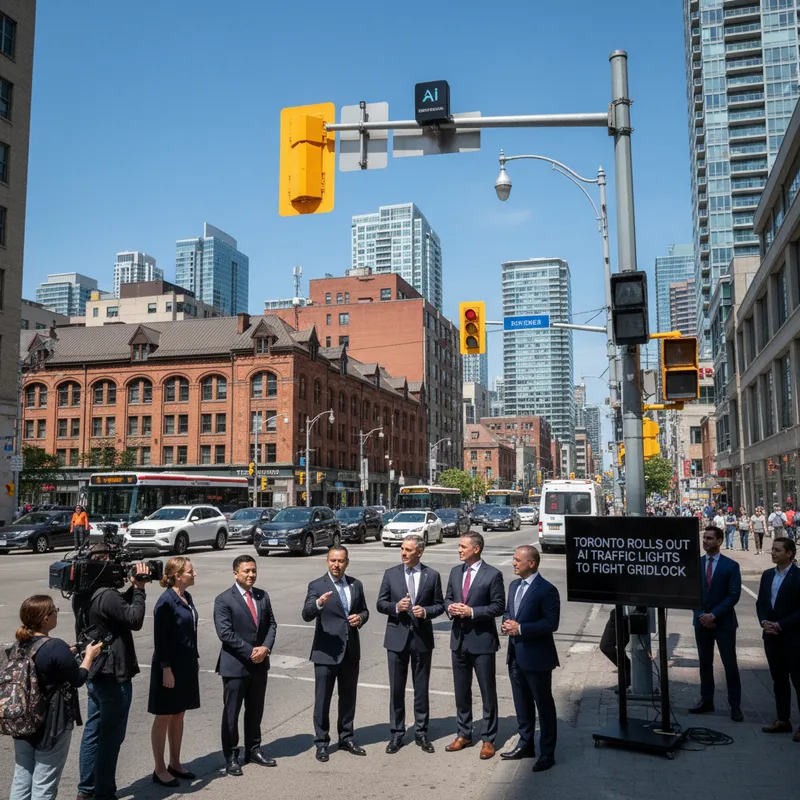
The City of Toronto is turning to artificial intelligence in its latest attempt to alleviate the city's notorious gridlock, with the first smart traffic signals set to be installed along a major artery in North York next month.
Following a successful test period, the new AI-powered system will be deployed in May on Yonge Street, covering intersections from Mill Street near York Mills Road north to Steeles Avenue. The technology is designed to detect changes in traffic volume in real time, automatically extending green lights and left-turning signals to improve flow and reduce delays.
This marks a significant shift from the city's current system, which relies on a 24/7 staffed traffic operations centre where employees manually adjust signals remotely. While that system will remain, the AI is expected to handle many situations independently, performing as well as, or even better than, human operators in some cases, according to city officials.
Roger Browne, the city’s director for congestion and network management, said on Tuesday that the AI has proven its capabilities. "We found that it was able to match or replicate the work of those traffic operations staff and, in some cases, do even a little bit better," Browne said.
How the smart signals work
Unlike traditional traffic lights that operate on fixed timers or require manual intervention, the new smart signals use sensors and algorithms to react to what is actually happening on the road. Browne explained that the system can adapt to unexpected and random traffic demands while minimising disruption to intersecting traffic across the entire network.
“It’s able to look at the entire mesh of traffic signals and make adjustments to the lights to favour demands in traffic that may be random and unexpected while minimizing the impacts on opposing traffic throughout the network,” he said. This autonomous control is particularly beneficial for managing the less predictable traffic patterns found in suburban areas, a key reason why the initial rollout is focused outside the downtown core.
The focus on suburban arteries like Yonge Street and, later, sections of Steeles Avenue East and West, is strategic. According to a city report on the congestion management plan, smart traffic signals are most effective in these areas where intersections are more standardized and traffic volumes are generally more predictable. By automating these sections, staff at the central operations centre can dedicate more attention to the complex and often chaotic intersections in downtown Toronto.
Managing North York's rapid growth
For residents and officials in the targeted areas, the technology offers a glimmer of hope amidst growing frustration over commute times. The ward of Willowdale, represented by City Councillor Lily Cheng, is one of the first to receive the upgrade.
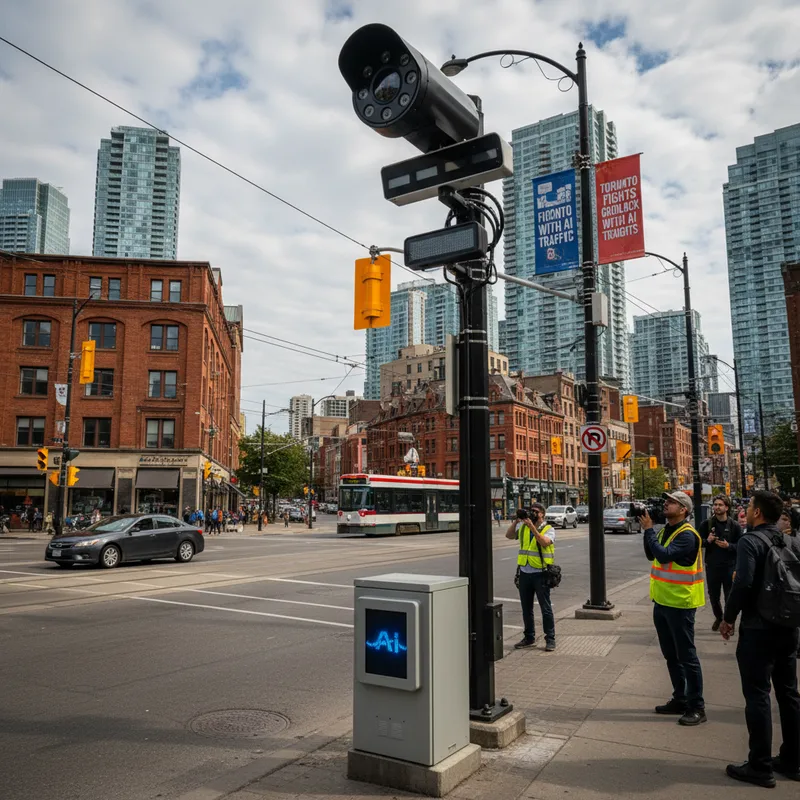
Cheng highlighted the urgent need for innovative solutions, noting that the North York Centre area is expected to absorb another 100,000 residents in the coming years. With no plans to add new lanes or expand road capacity, leveraging technology is seen as essential to keeping the community moving. This pressure is compounded by province-wide initiatives that could see increased density, like proposals to build homes on smaller lots.
We’re very excited about this because gridlock is a problem in our community and our community continues to grow. We don’t always get the traffic agents in our neighbourhood; in fact, we don’t. Most of them get assigned downtown so this will help us alleviate traffic.
Cheng emphasized that embracing new technology is critical for making future commutes manageable in the face of such rapid development.
A century of traffic innovation
Toronto's use of technology to manage vehicle flow is not a new phenomenon. In fact, the city has been a site of traffic innovation for over a century. The very first automated traffic lights in Toronto were installed at the intersection of Yonge and Bloor streets on August 8, 1925.
According to reports from the Toronto Daily Star at the time, the "flashing lights" were a novel concept. They replaced a police officer who previously directed traffic from the centre of the intersection. The new system used red, yellow, and green lights on corner poles, controlled by an automatic signal box that rotated the lights at half-minute intervals. The initial public reaction was one of confusion and adjustment, with the newspaper noting "MANY BLUNDERING" motorists who failed to notice the new signals perched above the street. However, drivers quickly adapted, finding the system "facilitates travel." This historical parallel highlights the city's long-standing reliance on technological solutions to address the persistent challenge of traffic congestion, a problem that has evolved from the early days of motoring to the complex gridlock of the 21st century. Similarly, massive infrastructure projects, such as the California high-speed rail, face escalating costs and evolving challenges.
Mixed feelings and future plans
While the city is optimistic, some Torontonians who live and work near the initial rollout area have expressed mixed feelings. "It’s worth a try. Better than doing nothing," said local resident Connor Arnold. Others were more skeptical. "I don’t think AI will solve the problem. I think more police of a police presence, maybe more red light cameras," said Gabe Sykes.
Maurice Yu, who works in the AI field, noted the limitations of technology without broader changes. "You can use it as best as possible to control the systems and to control lights but without government interjection, I think it’s going to be like this for a while," he said, questioning if people could be encouraged to use the TTC more.
The AI traffic signals are one of five key pillars in the city's broader Congestion Management Plan, which also includes shifting how people travel, deploying more traffic agents, improving public transit, and mitigating the impact of construction. Similar efforts to modernize transportation infrastructure are underway in other cities, such as in New Zealand where Auckland Transport is planning level crossing removals.
The project comes at a cost of $55,000 per intersection. The city plans to install 50 AI-powered signals this year and has a long-term goal of bringing 300 online across Toronto, which currently has a total of 2,500 signalized intersections. The measured rollout will allow the city to gather data and refine the system as it expands.