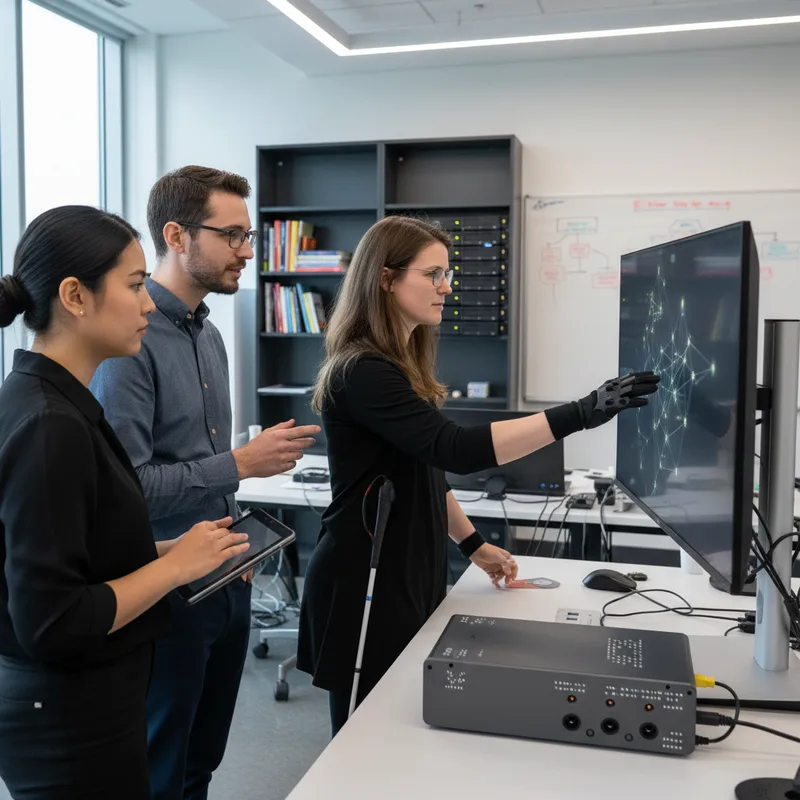
OCAD University researchers and alumni have launched a series of artificial intelligence projects aimed at improving accessibility and industrial efficiency across Ontario. The developments include the release of the world’s first standard on accessible AI and a new tool designed to assist visually impaired people in accessing video content. Dr. Jutta Treviranus, a professor at OCAD U, chaired the technical committee that developed the national standard for Accessibility Standards Canada. The standard is the first of its kind globally. It provides a framework for ensuring that AI systems do not exclude or discriminate against people with disabilities. The move comes as the university’s Digital Futures program graduates enter the workforce with new software solutions. Aaditya Vaze, an alum of the program, recently launched ViddyScribe. This tool uses AI to describe video content for people who are blind or have low vision. It aims to bridge a gap in digital media where visual information is often inaccessible to those with sensory impairments.
Mixed reality and the primary sector
Art and design applications are also moving into the agricultural sector. Associate Professor Dr. Alexis Morris led a project to develop a mixed reality tool for farmers. The system uses immersive visuals and AI to interpret complex farm data. Dr. Morris says the tool helps farmers make better decisions by making data easier to understand through visual representation. This intersection of tech and practical industry mirrors wider trends in the city. For example, TMX Group is preparing to host global leaders to discuss technical shifts in the resource sector. Both projects suggest a growing reliance on data-driven design to solve traditional logistical problems. The university is also expanding its work in the public realm. A new AI-driven light installation on University Avenue now interacts with pedestrians. The work, created by an OCAD U professor, uses sensors to engage with people as they walk past. This project follows a similar trajectory to wider cultural programming in Toronto, such as the TO Live 2026 schedule, which includes several interactive and digital-first performances.
Healthcare and dementia-friendly design
Designers are also working with the University Health Network to improve hospital infrastructure. A collaboration between OCAD U and UHN recently resulted in a redesigned shower room for patients with dementia. The project began in a Design for Health graduate studio before moving to the KITE Research Institute. The new facility is located at UHN’s Toronto Rehab University Centre. Researchers say the layout was designed specifically to reduce confusion and improve safety for patients. The project shows how academic research can move from a classroom concept to a physical installation in a clinical setting. The focus on social outcomes extends to the university's involvement in the DemocracyXChange summit. Scheduled for April 16 to 18 in Toronto, the event will examine the role of the economy in democratic systems. University staff and students are expected to participate in the summit to discuss how design impacts civic engagement.
Expanding educational pathways
As technology changes, the university is promoting its School of Continuing Studies to professionals looking to retrain. The school offers courses taught by industry professionals in fields like business strategy and healthcare design. These programs are designed for people who need to adapt their skills without committing to a full four-year degree. The university is also highlighting graduate programs that focus specifically on accessibility and business strategy. These degrees are marketed as a way to enter diverse career paths beyond traditional art galleries. Faculty staff say this flexibility is necessary in a changing job market. Student experience is also shifting toward digital production through the OCAD U LiVE platform. This program acts as an on-demand streaming service and content creator studio. It allows students to gain credits while producing digital media for a real audience. This type of vocational training is becoming more common across Ontario as schools look to provide practical workplace skills. The university continues to seek funding for these initiatives through various channels. Other local organisations are also seeing strong support for their goals. United Way Greater Toronto remains on track for its $112 million target. This funding often supports the social programs that academic institutions like OCAD U help to design. Registration for upcoming semesters is currently open via the university admissions office. International and local applications are being processed for the 2026 academic year. The university will hold its next series of information sessions for prospective students in March.