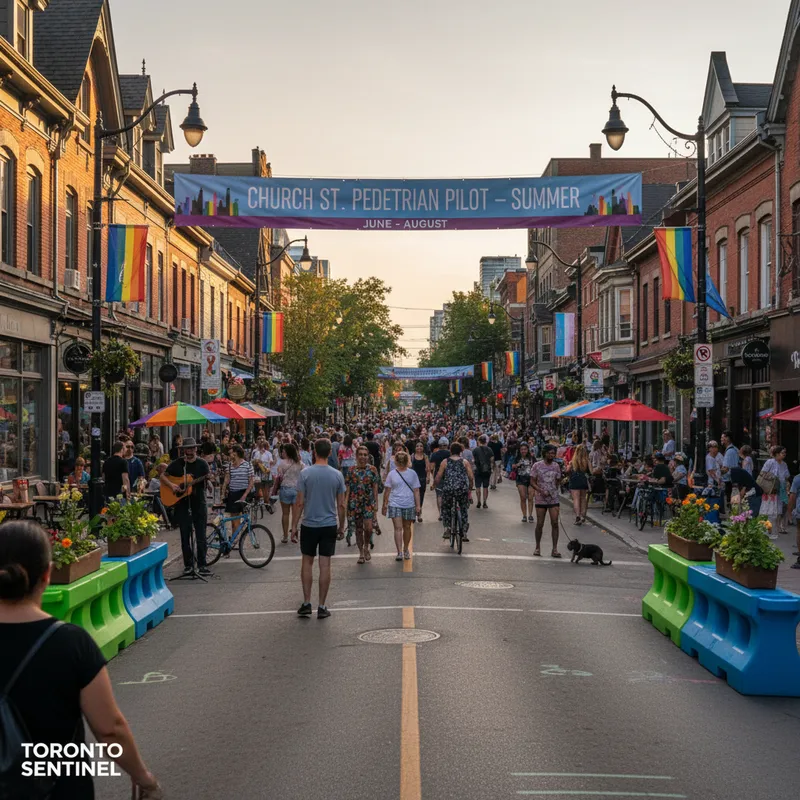
A slice of Montreal’s vibrant summer street life may be coming to Toronto, as a proposal to turn a section of Church Street into a pedestrian-only zone heads to city hall. Later this month, Toronto and East York Community Council will consider a motion from Coun. Chris Moise (Toronto Centre) to close Church Street between Alexander and Wellesley streets to all vehicle traffic for a two-month pilot project this summer.
If approved, the section of the popular Church-Wellesley Village would become a car-free haven from June 19 to August 21. The proposal aims to create a public space where people can gather and relax without the danger and noise of passing traffic. The vision draws inspiration from Montreal’s successful pedestrianization of Rue Sainte-Catherine, a bustling commercial artery that transforms into a pedestrian promenade every summer.
The proposed closure would affect a busy hub of the Village’s nightlife, encompassing some of its most well-known bars and clubs, including Crews and Tangos, Woody’s, and Sailor. The area is also just south of The 519, a vital community centre for the city’s LGBTQ+ population. While Toronto has a few smaller streets closed to cars, such as Gould Street on the Toronto Metropolitan University campus, turning a major street into a temporary pedestrian zone is a relative rarity for the city. Proponents are hopeful that a successful pilot on Church Street could pave the way for similar initiatives across Toronto.
From social media post to policy
The push for a car-free Church Street gained momentum from an unexpected source: social media. The initiative began last fall when local transit advocate Rodney Chan posted a conceptual map online illustrating what a pedestrianized Church Street could look like. Chan says he didn’t expect the post to lead to concrete action, but it quickly caught the attention of a staffer in Coun. Moise’s office.
It’s about encouraging residents to come to the city’s Church-Wellesley Village to ‘hang out, just relax. and not have to worry about being run over by a car.’
This digital spark led to months of collaboration between Chan, Moise’s office, and the Church-Wellesley Business Improvement Area (BIA). Together, they worked with city staff and the Toronto Police Service to refine the concept and address logistical challenges, bringing the idea from a social media "what if" to a tangible policy proposal. "It’s the posting to policy pipeline," Chan joked while speaking to reporters. This journey highlights a modern approach to civic engagement, where grassroots ideas shared online can influence municipal planning and policy. Similar environmental concerns are being debated in other regions, such as at northern beaches erosion, demonstrating a wider trend of addressing community-specific challenges. An online petition supporting the pilot has already gathered hundreds of signatures, demonstrating community interest in the project. This collaborative effort between residents, business leaders, and elected officials aims to create a more vibrant and people-centric space in one of Toronto's most historic neighbourhoods.
Removing cars could be good for business
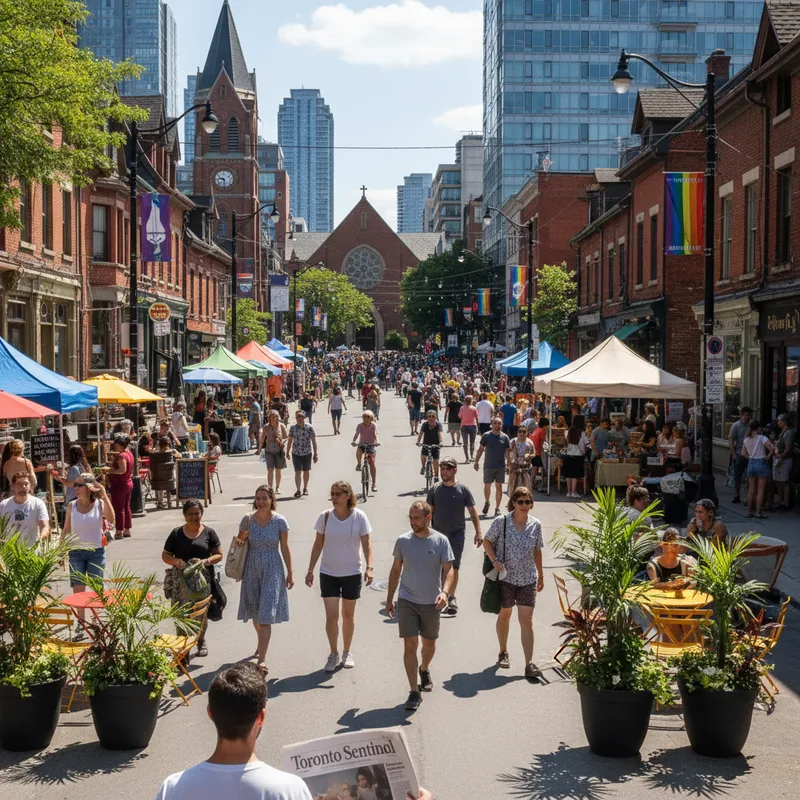
Local businesses are backing the proposal, anticipating a significant economic upside. Jaret Sereda, executive director of the Church-Wellesley BIA, says his members are supportive, citing evidence from other cities where pedestrianization has driven up revenue. The belief is that creating a more relaxed and inviting atmosphere encourages people to stay longer and, consequently, spend more.
During warmer months, the sidewalks along this stretch of Church Street often overflow with patrons moving between bars, clubs, and restaurants. By removing vehicles, the pilot would expand this social space from the narrow sidewalks onto the full width of the street. In response to the opportunity, the BIA is already planning a series of "activations" to animate the new public space, including DJs, live performances, and art installations. Even local commercial landlords have been supportive, offering sponsorships to help fund the initiative.
Possible parking woes addressed
While removing on-street parking can sometimes be a point of contention for businesses, it has not been a major concern in this case. Sereda notes that the area is well-serviced by public transit, with Wellesley Station nearby, and many people already arrive on foot or by bicycle. Furthermore, considerable off-street parking is available in the vicinity.
Coun. Moise also expressed confidence that the closure would not lead to major traffic disruptions. He pointed out that Church Street is not considered a major thoroughfare for traffic, and that Maitland Street, which intersects the proposed pedestrian corridor, will remain open to east-west vehicle movement. This plan is designed to minimize inconvenience for drivers while maximizing the benefit for pedestrians and local businesses.
The proposal also aligns with broader city efforts to simplify Toronto’s notoriously complex street signage. A separate city report from late 2025 highlighted the confusion caused by current parking signs, which led to over 1.8 million parking tickets in 2024 alone. Creating a clearly defined, car-free zone, even temporarily, offers a straightforward alternative to the clusters of signs that often leave drivers guessing.
A chance to ‘spread queer joy’
Beyond the economic and logistical considerations, advocates see the pilot as a powerful opportunity to reinforce the cultural significance of the Church-Wellesley Village. Rodney Chan believes the project will help "spread more queer joy" and revitalize the neighbourhood’s role as a central gathering place for Toronto’s LGBTQ+ community.
Chan notes that as society has become more accepting, the queer community has grown less geographically concentrated, and the Village no longer holds the same central role it once did. Combined with rising development pressures that threaten local businesses, there is a sense that the neighbourhood’s unique identity needs to be actively nurtured. The pedestrianization pilot, he argues, can help "cement the significance" of the strip by drawing more people to the area for events beyond the annual Pride festival or Halloween celebrations.
The hope is to create a dynamic and celebratory atmosphere throughout the summer. "We need more space, and this is a perfect opportunity for more street art, more seating and more performances," Chan says. "It will offer more space to celebrate." If successful, Coun. Moise says he hopes this is not merely a one-off experiment. "I hope it’s not just a one-time thing, but the start of something great for the city," he said.