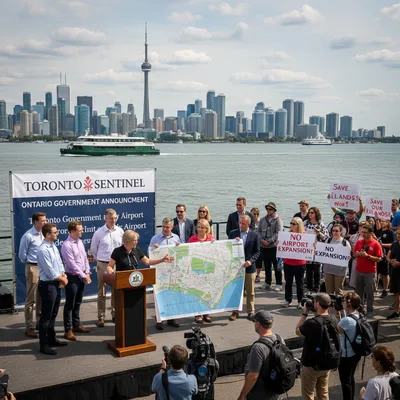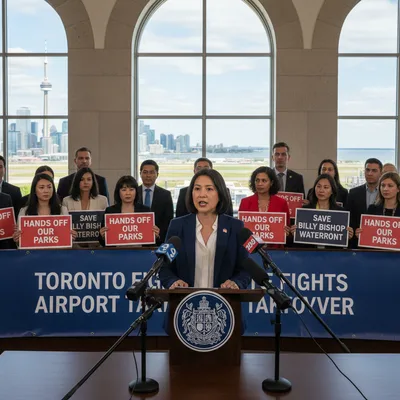
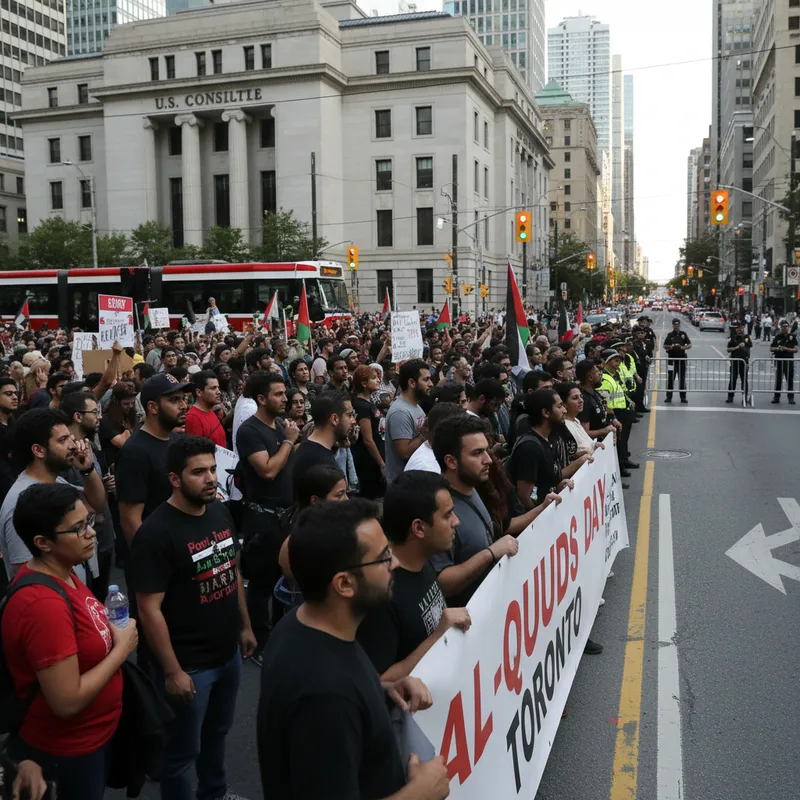
An Al-Quds Day rally went ahead near the U.S. Consulate in downtown Toronto on Saturday after an Ontario Superior Court judge dismissed an eleventh-hour bid by the province to block the event, setting up a charged test of protest rights and public safety in Canada’s largest city.
The decision cleared the way for demonstrators to gather on University Avenue, after a noon hearing where lawyers for Ontario’s attorney general and the Al-Quds Day committee made submissions. The judge said reasons would follow later in the day.
Ruling preserves right to assemble, with reasons to come
Stephen Ellis, a participant who also acts as a lawyer for the organisers, said attendees were relieved by the outcome after hours of uncertainty. He described the morning as filled with “fear-mongering” and “desperation,” and added that those on the march felt their rights had been vindicated.
“We were confident it wasn’t going to succeed. It’s absurd that they would abrogate our rights,” Ellis said. “The attempt for the injunction was a politically motivated attack on our rights and so we were happy to vindicate those rights today.”
Ellis framed the demonstration in broader terms. “We live in a period of intense crisis all over the world,” he said. “We have to build a better world and that’s more important now than ever before.”
The court’s refusal to grant the injunction means the province’s extraordinary step to curb a permitted demonstration did not meet the threshold, at least on an interim basis. Civil liberty groups have warned such measures risk chilling free expression and peaceful assembly. The full legal reasoning, which had not been released by press time, is expected to address how the judge weighed the Charter right to protest alongside public safety concerns raised by officials.
Ford slams decision, cites safety and security
Premier Doug Ford said he was “extremely disappointed” with the ruling and reiterated concerns about safety in a post on social media shortly after the court cleared the event.
“While the judge cited Canada’s Charter of Rights and Freedoms, when we talk about rights we need to be clear that every person has the right to safety and security,” Ford said. “We need to be clear that no one in Canada has the right to incite violence or free licence to intimidate and hate.”
Ford argued the event has long been “a venue for antisemitism, hatred, intimidation and the glorification of terrorism.” He added: “I won’t stop working to put an end to the hatred and division that runs too rampant on Canada’s streets. I won’t stop working to protect the greatest province in the greatest country in the world.”
The premier had publicly urged the attorney general to seek an injunction on Friday, calling the rally a “breeding ground for hate and antisemitism.” One of Ford’s first promises after taking office in 2018 was to pursue an outright ban on the annual event.
Heavy police presence, two arrests reported
Toronto police bolstered their presence downtown ahead of the rally, saying they anticipated a crowd of about 3,000, with the potential for more amid heightened tensions linked to conflict in the Middle East. Officers on bicycles and on foot were visible along the march route and around the consulate area for much of the afternoon.
Police said two arrests were made at a demonstration at University Avenue and Armoury Street. They did not immediately specify which gathering the arrests were connected to and indicated further details would be released later via a news statement.
Organisers have previously characterised Al-Quds Day in Toronto as a show of support for Palestinians; this year’s promotion also signalled opposition to war in Iran and Lebanon. A counter-demonstration formed outside the U.S. Consulate.
Counter-protest voices anger at rally and province’s approach
Salman Simr, who helped organise the counter-protest, called it “disgusting” that the Al-Quds Day rally was defending the Iranian regime. He argued the province should have gone further than an injunction bid to halt the gathering.
“It was a political show by Ford,” Simr said. “He doesn’t need any court order. He’s a premier and he has a duty, he has power and full authority to implement the law.”
Simr added: “If Ford, [Prime Minister] Mark Carney, Toronto police, [Toronto] Mayor [Olivia] Chow, they don’t want to do their job, we the people … have the duty to stand.”
Security backdrop: shots fired at synagogues and the U.S. consulate
The legal fight and the duelling rallies unfolded amid unease across the GTA after a series of incidents in the past two weeks in which shots were fired at three synagogues and at the U.S. Consulate. Investigations remain active, and officials have labelled the climate tense.
The Centre for Israel and Jewish Affairs welcomed the province’s move to seek an injunction on Friday, arguing the event is “a platform for extremist rhetoric, antisemitic conspiracy theories, and support for terrorist organizations.” Supporters of the Toronto march reject that characterisation and say the annual event is an outlet for political speech that must be protected.
Al-Quds — Arabic for Jerusalem — is typically marked on the last Friday of Ramadan. The event’s modern iteration was popularised in Iran after the 1979 revolution, a historical association that has placed the march under intense scrutiny in Western cities. This year, policing concerns have intensified elsewhere too: the British government, acting on a request from police, banned the Al-Quds Day march in London.
Rights, limits and the path ahead
The judge’s reasons will likely touch on the balance between core Charter protections and the state’s obligation to protect public order. In practical terms, that often comes down to whether the anticipated risk can be managed through conditions, policing and communication with organisers, rather than prior restraint on speech.
For City Hall and police, the test extends beyond a single afternoon. Toronto’s event calendar is entering its busiest stretch, with crowds expected across neighbourhoods for concerts, parades and cultural gatherings throughout the season. See our guide to what’s on in the months ahead: Toronto spring festival lineup confirmed for 2026 season.
Community leaders are also looking to create space for dialogue outside street demonstrations. Literary and music events profiling new voices are among those efforts, including the upcoming Newcomer writers to lead Qissa Festival at Small World Music. Across the city, neighbourhood initiatives continue to draw residents together for practical, non-partisan activities such as the Free Repair Cafe to help Scarborough residents fix broken goods.
Beyond Toronto, Ontarians are preparing for a busy arts and events season elsewhere, too. For a regional snapshot, see London Ontario events March–June 2026: what’s on.
It isn’t yet clear whether the province will seek additional legal remedies after Saturday’s setback. Any appeal would have to grapple with the high bar Canadian courts set for prior restraints on political speech in public forums. In the interim, city officials and police services across the GTA are expected to update operational plans for large-scale protests and counter-protests as Ramadan concludes and spring events begin in earnest.
Whatever the next legal steps, the day’s rallies in Toronto underscored the strain of a combustible moment: the collision of diaspora politics, local security concerns and a constitutional order that strongly favours speech and assembly, even — and especially — when the content offends. As Ellis put it, the stakes now are bigger than one march: “We have to build a better world and that’s more important now than ever before.”