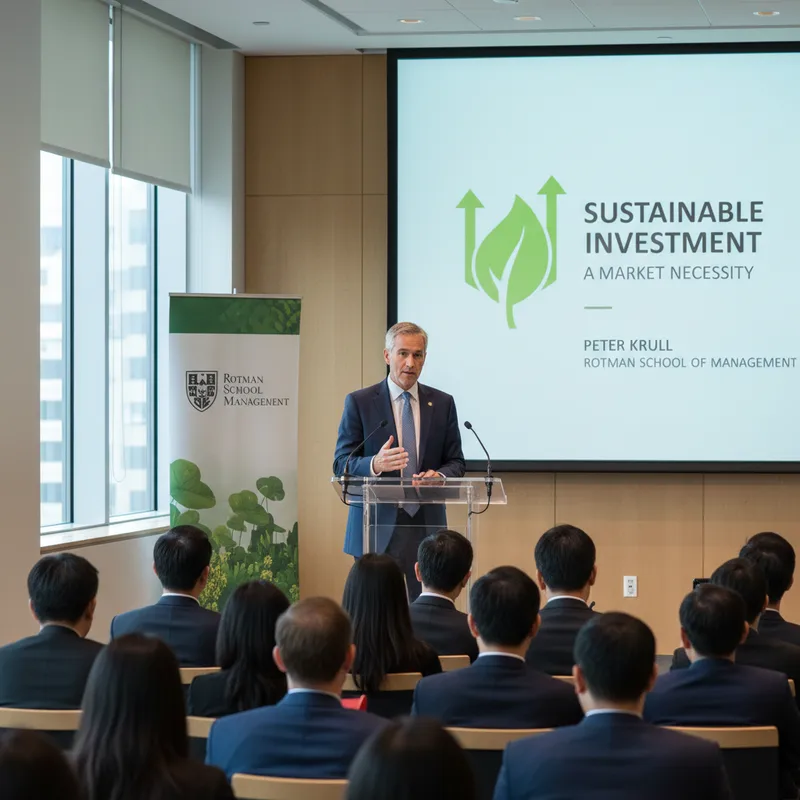
Investment strategist Peter Krull told a Rotman School of Management audience that the shift toward sustainable finance is becoming a permanent fixture of global markets rather than a temporary trend. Krull addressed the University of Toronto forum on March 2 to discuss the evolving role of the 'sustainable investor' in the current economic climate. The event focused on how environmental and social factors are increasingly dictating where capital flows. Krull argues that investors who ignore climate risks are mispricing their assets and could face significant losses as regulations tighten across North America and Europe. Recent data suggests this shift is already under way in Toronto. Local institutions are increasingly aligning with global climate goals, which mirrors broader trends seen in cities such as Melbourne, where the Footscray West Writers Fest has previously explored the ethics of local divestment.
The rise of climate-conscious capital
Krull noted that the sustainable investment sector has moved beyond simple exclusion lists where investors avoided tobacco or firearms. He argued that modern sustainability is about identifying companies with low carbon footprints and transparent supply chains. According to Krull, these firms are often better positioned to survive the transition to a low-carbon economy. The Rotman School of Management has hosted several speakers on this topic as business schools face pressure to update their curricula. The school is currently integrating these concepts into its finance programmes to meet the demands of a changing job market. Figures from the Global Sustainable Investment Alliance show that sustainable investment assets reached over $35 trillion globally in recent years. This represents about a third of all professionally managed assets in major financial markets. Krull said this growth is driven by both institutional demand and a shift in retail investor preferences.
Regulatory pressure and transparency
Financial regulators in Canada are moving toward mandatory climate disclosures for banks and insurance companies. Krull told the audience that this transparency will make it harder for companies to 'greenwash' or exaggerate their environmental credentials. He said that data-driven reporting is the only way to ensure the market remains stable during the energy transition. This move toward standardisation is a priority for educational and professional bodies. For instance, OCAD University is currently leading work on global standards in related tech fields. Krull believes similar rigour is now required for environmental auditing. The talk also touched on the risks of political backlash against sustainable investing. Krull acknowledged that some jurisdictions have pushed back against ESG (Environmental, Social, and Governance) criteria. However, he maintained that the financial reality of climate change will ultimately override political cycles.
Impact on the toronto market
In Toronto, the financial sector is seeing a surge in demand for specialists who can navigate these new requirements. Organizations like United Way Greater Toronto are also observing how donors and partners are increasingly concerned with the ethical implications of their endowments. Krull highlighted that the mining sector, a staple of the Toronto Stock Exchange, is under particular scrutiny. Investors are now asking for specific details on water usage, land reclamation, and carbon emissions from major mining operations. These issues are set to dominate discussions at upcoming industry events like the PDAC 2026 convention. The transition is also affecting how younger generations prepare for careers in finance. Krull suggested that the next decade of investment management will require a deeper understanding of environmental science than ever before. He noted that universities are currently the primary testing grounds for these new cross-disciplinary approaches.
Future outlook for investors
Krull concluded by stating that the definition of a 'good' return is changing. While profit remains the primary goal, the timeframe for measuring that profit is lengthening to include the long-term costs of environmental degradation. He said that the most successful investors will be those who can balance immediate gains with the health of the broader ecosystem. The Rotman School of Management has made the full recording of Krull’s presentation available on its digital archive. The school plans to host a follow-up panel on green bonds and municipal sustainability projects in the spring semester.