
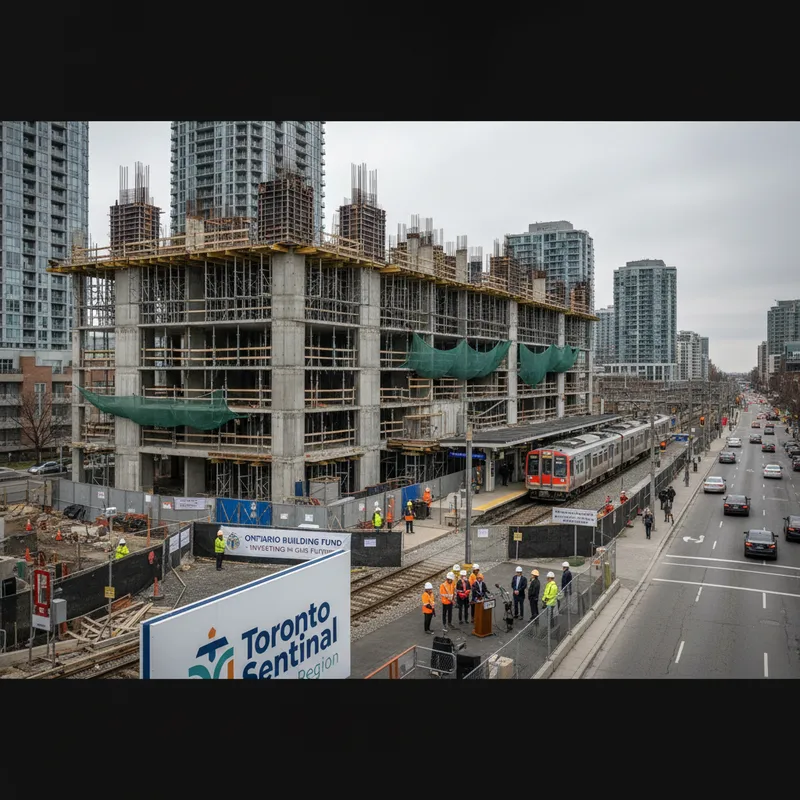
The Ontario government is injecting up to $178 million into a stalled rental housing development in Scarborough, a move aimed at creating 1,700 new rental units but one that is drawing criticism as a taxpayer-funded bailout for developers. The investment comes from the province's recently established Building Ontario Fund, an independent Crown agency tasked with financing critical infrastructure projects that also generate a financial return.
The project is a key component of the new Scarborough Junction community, a massive development expected to eventually include 7,700 homes, along with new parks and public amenities. The provincial funds are structured as an "equity investment" in a joint venture with developers Republic Developments and private equity firm Harlo Capital. According to a provincial press release, the project had stalled due to financing challenges before the government's intervention.
This marks the second time the fund has been used to support market housing. In March, the province announced a $300-million investment with High Art Capital to acquire 2,200 unsold condominium units and convert them into rentals, addressing a cooling condo market.
A 'game changer' for Scarborough housing
Matt Young, the president and CEO of Republic Developments, called the government's decision a 'game changer' for the project. In an email, he confirmed the Building Ontario Fund is taking a 50 per cent equity stake in the development's first phase. He noted that his firm had always intended the site to be mixed-use, exploring both condominium and rental housing on a phase-by-phase basis.
A significant portion of the new housing will be designated as affordable. According to Young, 340 units, or 20 per cent of the total, will be part of the City of Toronto's Rental Housing Supply Program for a period of 40 years. A city spokesperson confirmed they anticipate an application from the developer for the program. The city defines these affordable units as housing for which a household in the 50th to 60th income percentile would pay no more than 30 per cent of its income. This initiative could offer some relief for residents struggling with the high cost of living, a challenge many face when dealing with unexpected expenses.
Young says Republic Developments submitted a proposal that aligned with the fund’s mandate to invest in affordable housing. The project's proximity to the Scarborough GO Station makes it a transit-oriented community, a key factor in its selection.
Investment strategy and public returns
The Building Ontario Fund operates as a for-profit Crown agency, designed to attract private capital and bridge financing gaps for essential projects. Julia Sakas, a spokesperson for the fund, said in an email its mandate is to “close financing gaps and enable priority infrastructure projects to move from vision to reality.”
Sakas highlighted the Scarborough project's strengths, including its transit connectivity and its role in delivering new rental supply to an underserved area. She explained that the fund's return on investment is not solely financial. While it expects a return through capital appreciation based on the increase in land value from site improvements, it also measures success by public benefits.
Project profitability and affordability are not mutually exclusive. We also measure our return based on the public benefits associated with the project, which in this case is long-term affordable housing connected to transit.
The fund's portfolio spans six priority sectors: affordable housing, energy, transportation, long-term care, municipal and community infrastructure, and critical minerals. According to Sarah Chapin, a spokesperson for the Minister of Finance, the fund is focused on “high-impact, revenue-generating infrastructure projects that otherwise would not happen.” The strategy echoes broader government efforts to fund essential services, similar to the recent opening of a new medical school in Brampton to address physician shortages.
'An enormous government bailout' say critics
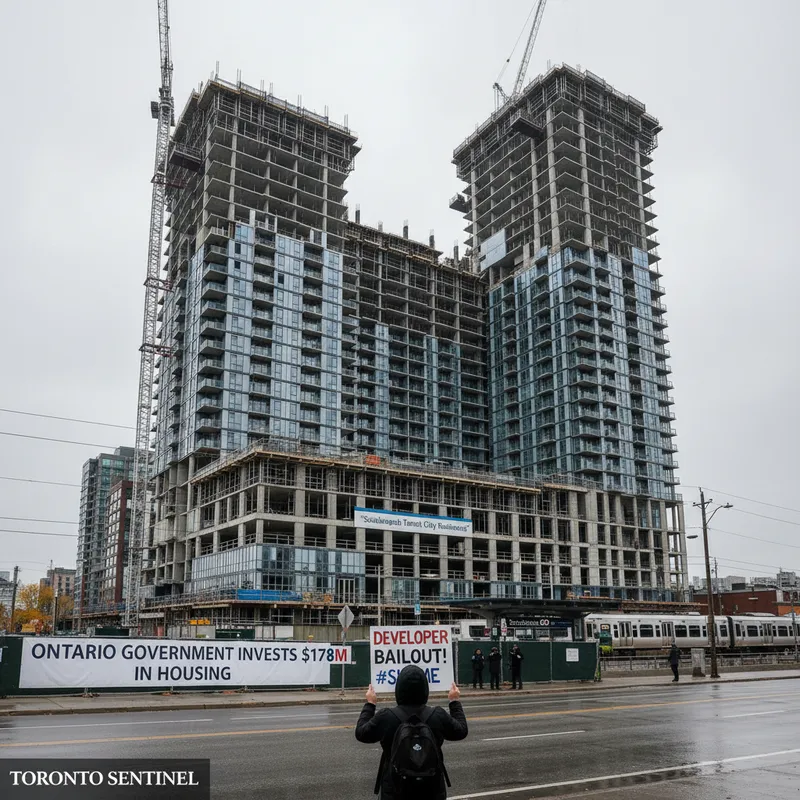
Despite the government's stated goals, the investment has drawn sharp criticism. Some housing advocates argue that it represents a bailout for private developers at the public's expense, rather than a sustainable solution to the housing crisis.
Jeremy Withers, a senior researcher with New Housing Alternatives at the University of Toronto, described the move as part of an “enormous government bailout” for the development industry. He pointed to other recent provincial measures, such as HST and development charge cuts, as part of a pattern aimed at supporting a specific model of development.
Withers also raised concerns about the involvement of financial firms in the housing market, citing research suggesting they can be more aggressive with evictions. He noted that alternative models, such as a large co-op housing project also under way near Scarborough Junction, could provide more permanently affordable, community-controlled housing.
Ricardo Tranjan, a senior researcher with the Canadian Centre for Policy Alternatives, echoed these concerns. He argued that a better model would be for the government to build housing directly. He also pointed out that the new market-rate units in the Scarborough project will not be subject to rent control. “We can’t have housing be an extremely attractive investment and be affordable. We can’t square that circle,” Tranjan said.
Context of a struggling condo market
The government's intervention comes as the condominium market in the Greater Toronto and Hamilton Area (GTHA) faces significant headwinds. According to real estate research firm Urbanation, the first quarter of this year saw zero new condo project launches for the first time in three decades. The government's intervention comes as the condominium market in the Greater Toronto and Hamilton Area (GTHA) faces significant headwinds. According to real estate research firm Urbanation, the first quarter of this year saw zero new condo project launches for the first time in three decades. Investor interest has waned, leaving an oversupply of small units. In the first three months of the year, nearly 1,000 planned condo units across the GTHA were cancelled and are now being converted into rental properties. This market shift provides context for why projects like Scarborough Junction might be stalled, unable to secure private financing amid economic uncertainty. This situation parallels volatility in other key Canadian sectors, such as the energy industry, which often sees large gatherings like the Global Energy Show in Calgary to discuss industry-wide challenges and investment. Additionally, many Ontarians are looking for ways to enjoy their summer, with popular destinations like the best beaches in Ontario seeing increased interest.
The province’s strategy appears to be a direct response to these market conditions, using public funds to ensure that stalled condominium projects can be repurposed into much-needed rental housing. However, the debate continues over whether this is a prudent investment in housing supply or a rescue plan for private interests.
Looking ahead, the Building Ontario Fund intends to sell its interest in the Scarborough project once the buildings are completed and occupied, subject to market conditions. According to Sakas, the first phase of the development is scheduled for completion and initial occupancy starting in late 2030.